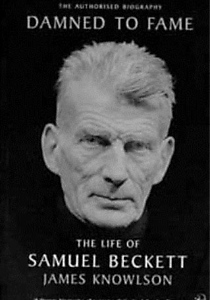
This well-written and extensively researched biography traces the life of Samuel Barclay Beckett from his birth at Cooldrinagh in Foxrock, then an affluent rural suburb of Dublin, on Good Friday, 13 April 1906, to his death in Paris on 22 December 1989.
The title of the biography derives from a phrase Beckett himself wrote in a notebook in 1981, during the attention surrounding his seventy-fifth birthday: “damned to fame”. He had extracted the words from Alexander Pope’s The Dunciad, Book III: “All crowd, who foremost shall be damn’d to Fame.” The phrase perfectly captures the paradox of Beckett’s later life. He had spent years resisting public attention, yet became one of the most celebrated writers of the twentieth century.
Samuel Beckett was educated at the historic Earlsfort House bilingual (French and English) preparatory school in Dublin and later at Portora Royal School in Enniskillen. He excelled academically and was particularly interested in literature and languages. Like his father, he enjoyed team sports, particularly cricket and rugby, but he was also fond of swimming and had a passion for hillwalking and diving. His enjoyment of walking was deeply connected to youthful rambles with his father, Bill, of whom he was very fond. In 1923, he entered Trinity College Dublin, where he studied French and Italian, graduating in 1927.
After university, Beckett taught briefly at Campbell College in Belfast. In November 1928, he arrived in Paris, where he became a lecteur d’anglais at the École Normale Supérieure, remaining there until 1930.
Paris was something of a revelation to Beckett, and he came to establish an enduring relationship with the city. Living there brought him into the literary circle surrounding James Joyce, to whom he was introduced by Tom MacGreevy. He became an important member of Joyce’s circle and assisted with research for Joyce’s increasingly experimental Work in Progress, which gradually developed and was eventually published as Finnegans Wake.
Beckett admired Joyce, but the relationship also helped him understand what kind of writer he did not want to become. Joyce was attempting to make language increasingly rich and encyclopaedic; Beckett would gradually move in the opposite direction, towards simplicity, repetition, fragmentation and quietness. Although his theatre was influenced by Joyce, Beckett stated that the greater influence were the plays of John Millington Synge. He was drawn to Synge’s humour, “his stark but resilient tragicomic vision, his imaginative power and clear-sighted pessimism”. He was also helped to move away from Joyces influence by undergoing two years of intensive psychoanalysis with Dr. Wilfred Bion in London at the Tavistock Clinic.
In 1945, while visiting his mother in Foxrock, Beckett experienced an epiphany that is sometimes mistakenly regarded as being mirrored in the “vision” experienced by the solitary Krapp in the fictional one-act play Krapp’s Last Tape. The wild, stormy night and the harbour setting undoubtedly appear to correspond to the inner torment of a man searching to find his own way. In speaking of his revelation, however, Beckett placed greater emphasis on his own foolishness and folly as he began to awaken to the painful awareness of his impotence and ignorance. He came to understand that he should write from his own nescience and limitations rather than attempting to imitate the literary knowledge and mastery represented by Joyce.
This shift led to a more stripped-back approach to his writing, resulting in the novels that would form his celebrated trilogy: Molloy, Malone Dies and The Unnamable. Written in French rather than English, the novels abandon many of the traditional conventions of fiction. Their narrators struggle to establish who they are, where they are and even where their own voices originate. Molloy and Malone Dies were published in French in 1951, followed by The Unnamable in 1953.
In 1948–49, Beckett wrote En attendant Godot in French. The play was eventually translated into English as Waiting for Godot and was first performed in Paris in 1953.
Two men, Vladimir and Estragon, who depend on one another, wait beside a tree for someone named Godot. They are uncertain about who Godot is, and he never arrives. As they wait, they talk, quarrel, recall events imperfectly, consider leaving, but repeatedly decide to stay.
Beneath the play’s apparent simplicity lies a rigorous theatrical experiment. It departs from conventional plot structure, offers no traditional resolution, and relies heavily on repetition.
Waiting for Godot was followed by a series of increasingly austere plays. Endgame appeared in 1957. Its characters inhabit a confined interior world from which there seems to be no escape. Hamm is blind and unable to stand; Clov can stand but apparently cannot sit. Hamm’s elderly parents, Nagg and Nell, live in dustbins. The play bends dependency, habit, memory and mortality into a dark comedy.
Beckett’s mature writing repeatedly works through subtraction. The prose becomes more spare. The settings become increasingly empty. Characters lose possessions, histories, names and sometimes bodies. The language itself is subjected to erosion. Worstward Ho reduces narrative close to fragments of verbal survival: “Ever tried. Ever failed. No matter. Try again. Fail again. Fail better.” The sentence has often been treated as an inspirational maxim, but within Beckett’s work its meaning can be interpreted as darker and more ambiguous. It belongs to a body of writing engrossed with repeated failure and the impossibility of achieving any form of final certainty.
Other plays became progressively shorter and more concentrated. Krapp’s Last Tape (1958) presents an old man listening to recordings of his younger self. Happy Days (1961) places Winnie in a mound of earth, gradually becoming more physically trapped while continuing to speak with a determined optimism. In later works such as Not I, That Time, Footfalls and Rockaby, Beckett draws theatre much closer to voice, movement, stillness, light, sound and a quietness which could facilitate the coming of silence.
Beckett possessed a vibrant sense of humour, evident in the vulgarity, repetition, verbal games and precise comic timing that permeate his work. The comedy of his characters ranges from the humour of Vladimir and Estragon to the grotesque comedy of Pozzo and the exchanges between Hamm and Clov. Even the dark trilogy reveals an extraordinary appetite for linguistic playfulness.
The deepest comedy in Beckett frequently arises from the contradiction between the dignity human beings imagine for themselves and the indignities to which bodies and language reduce them. His characters wait, creep, crawl, fall, forget, urinate, eat, sleep and endlessly repeat themselves. Their suffering is true, but their attempts to give that suffering some grandeur are, time after time, perforated. As in Shakespeare’s Macbeth where humour plays a vital role, Beckett drew on laughter not as a decoration to be added to the darkness, but as part of a method of facing it.
One element in particular in Krapp’s Last Tape relates directly to Beckett’s own life experience: the darkness of the inner world. He came to view this inner darkness as his most precious ally, “his true element at last and the key to the opus magnum”. Light was rejected in favour of darkness:
As Jacob Needleman wrote in A Sense of the Cosmos, we awaken to darkness.
A second major development that would shape Beckett’s later explorations was his decision to draw increasingly on his own inner world for his subject matter, rather than relying primarily on conventional reality. He began to reject the principle underlying the work of James Joyce, among others: the belief that greater knowledge offered a means of understanding and controlling the world. In doing so, Beckett moved away from writing techniques founded on this assumption.
In future, his work would focus on poverty, failure, exile and loss—as he put it, on man as a “non-knower” and as a “non-can-er”. Though the revelation had a profound influence on his work, it should not distort his determined and consistent effort to pay heed to his own feelings and, to the best of his ability, raise the quality of his writing. As his writing developed, themes and influences embedded in him came more to the fore, particularly his interest in the ancient Greek philosopher Democritus’s view that “nothing is more real than nothing”.
Beckett’s work explores more than solitude and nothingness; it examines the inescapable persistence of human connection in a world where meaningful relationships seem impossible. This tension is captured in the closing words of The Unnamable (1953): “you must go on, I can’t go on, I’ll go on.”
James Knowlson’s sweeping biography offers a wealth of detail about the life of Samuel Beckett: the wide range of influences upon him, his extensive reading, his love of art, especially the Old Masters, and his fondness for music. His extensive knowledge and understanding of both art and music had a profound influence on the shape of his literary genius.
The book offers views of the scholar, sportsman, friend, lover, member of the French Resistance, years of ill health, close brush with death, reluctant celebrity, and old man. It traces the slow transformation, through human suffering, of the gifted, sometimes petulant and arrogant youth into a man who, although still demanding of those who worked with him, radiated simplicity, humility, all the while offering his understanding and undivided attention to his many friends.
Just as Van Gogh seemed born to paint, Samuel Beckett appeared destined to write. Once he had committed himself to his vocation, he received the guidance and support of some of the finest editors and publishers of his time, while attracting actors of exceptional ability to perform his work.
Among these was Billie Whitelaw, who collaborated with him for more than twenty-five years in physically and psychologically demanding roles. Beckett frequently adapted his exacting rhythmic and vocal requirements specifically to her abilities. Jack MacGowran also became one of the leading male interpreters of Beckett’s stage and radio works during the 1960s, as did Jack Magee, whom Beckett greatly admired.
Beckett was deeply familiar with Ireland’s geographical and religious folklore. In his early short-story collection More Pricks Than Kicks (1934), he includes a story entitled “Walking Out”, in which the protagonist, Belacqua Shua, explicitly refers to St Patrick’s Purgatory on Station Island, Lough Derg, in County Donegal. He compares a difficult walk or ordeal to the severe barefoot penance undertaken by pilgrims at this sacred site.
Beckett was an avid scholar of Dante Alighieri’s Divine Comedy, particularly the imagery of Purgatory. Historically, Lough Derg was known widely across medieval Europe and was an important source of European lore surrounding the afterlife, influencing continental concepts of Purgatory, including traditions and texts that formed part of the intellectual background to Dante’s work.
Damned to Fame provides a wealth of information, perhaps so much that, as John Banville observed in his review for The New York Review of Books, the accumulation of facts threatens to overwhelm the work. Nevertheless, certain significant influences receive insufficient attention from Knowlson. These include the indirect impact of Japanese Nō (Noh) theatre, particularly its ghostly dream plays, on Beckett’s minimalist late drama, as well as the profound influence of mystical writings, especially those of Meister Eckhart.
A strikingly brief stage direction appears in the manuscript of Waiting for Godot, accompanying Lucky’s dance: “danse (voir Noh)”—“dance (see Noh).” The extent of Beckett’s knowledge of Lafcadio Hearn remains uncertain, although he refers to him explicitly in a 1937 letter to his friend Mary Manning Howe, written while travelling through Europe.
Beckett reportedly stated that he had never seen a Nō performance. Nevertheless, the connection between his work and Nō theatre is evident, mediated largely through W. B. Yeats’s Nō-inspired plays, with which Beckett was well acquainted. Beckett’s relationship with Nō is therefore best understood not as a direct appropriation of Japanese theatrical form, but as a modernist transmission of its dramaturgy of absence, ritualised movement and evocation, conveyed particularly through Yeats.
Yeats encountered Nō through Ezra Pound and Japanese Nō translations and incorporated its principles into plays such as At the Hawk’s Well. Minako Okamuro offers the view that in his television play but the clouds Beckett draws structurally and thematically on both mugen Nō (the traditional Japanese “dream” or “phantom” Nō theater) and W.B. Yeats’s adaptation of Nō aesthetics.
Eckhart’s negative theology and his conception of nothingness resonate strongly with several central themes in Beckett’s literature. Eckhart described ultimate reality as a state of “pure nothingness” (ein bloßes Nicht), an idea that finds a parallel in Beckett’s sustained exploration of the void in works such as Waiting for Godot and The Unnamable. For both men, nothingness represents more than mere emptiness, vacancy or absence; it constitutes a profound state of being with the potential for reconciliation.
In a conversation recorded by the French writer Charles Juliet in November 1977, Beckett expressed his admiration for the mystics, including Meister Eckhart and St John of the Cross: “The mystics… I like… their illogicality… their burning illogicallity—the flame… the flame… which consumes all our filthy logic…”
Beckett’s writings and performances combine a profound religious dimension with a distinctive and often richly comic sensibility, eliciting both sorrow and joyful laughter. At moments, the experiences explored in Damned to Fame seem to extend beyond Beckett’s own life to encompass aspects of the human condition more generally.
More than a biography of Samuel Beckett, Damned to Fame offers an exploration of the human desire for knowledge in the face of the ultimately Unknowable.
———————————————————————————
Notes
i James Knowlson was a friend of Samuel Beckett for nineteen years and became, in Beckett’s words, his ‘sole authorised biographer’.
Damned to Fame. The Life of Samuel Beckett was published with Bloomsbury Publishing in London and Simon and Schuster in New York in 1996.
Deirdre Bair’s – Samuel Beckett: A Biography was published in 1978. Though not an officially authorised biography, Beckett did offer Bair his support. Unlike Knowlson she did not have access to his German notebooks. These were published in August 2026 by Suhrkamp Verlag under the title, Samuel Beckett German Diaries 28 September 1936─1 April 1937.
ii Trinity College founded in 1592 was originally envisioned to be an open-ended collegiate university modelled after Oxford and Cambridge—consisting of many colleges, with Trinity designated as the mater universitatis. However no further colleges were added to the initial phase.
iii The words are placed in a text based art facade outside Kevin St. Garda (Police) station in Dublin. They are included among quotes of modern Irish authors and extracts from medieval Irish texts notably the Amra Colum Cille, and the Navigatio Sancti Brendani, selected because the station stands adjacent to the ancient Palace of St Sepulchre and the Liberties―an area deeply intertwined with Dublin’s literary tradition.
iv Though Beckett rarely spoke of William Shakespeare as a direct influence he left a deep, structural, and textual imprint on Beckett’s work.
v While walking home with two friends he was severely stabbed in the chest on Avenue d’Orléans, Paris, in January 1938
vi The traditional pilgrimage involves demanding practices, including barefoot walking, fasting, repeated prayer and prolonged wakefulness. It cannot be undertaken through the mind alone; rather, it requires physical endurance as the body is drawn through prayer towards surrender.
vii Patrick Lafcadio Hearn (1850 – 1904) was born in Greece and raised In Ireland. He arrived in Japan in 1890 and gradually became the beloved Japanese cultural icon Koizumi Yakumo. He played a significant role introducing the culture and literature of Japan to the West. His collections of Japanese Tales and ghost stories such as Kwaidan (“ghost story”) leave a strong impression.
viii Beckett, Yeats, and Noh: …but the clouds…as Theatre of Evocation
Minako Okamuro