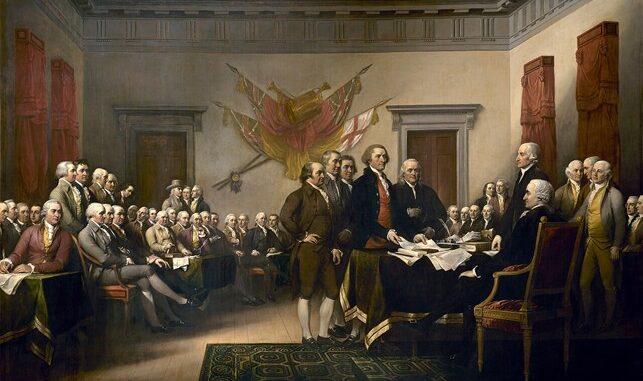
Presentation of the draft of The Declaration of Independence to Congress
Artist: John Trumbull
One who has seen the present world has seen all that ever has been from time everlasting and all that ever will be into eternity; for all things are ever alike in their kind and their form.
Marcus Aurelius: Meditations 6.37
While standing in my youth on a clear, sparkling day in a parking lot in Los Angeles gazing towards the distant San Bernardino mountains I received a strong intuitive insight, I was standing in the country that would either save or destroy the world. Nothing I have heard, seen, or read since has altered this view. I also harboured at that time and continue so, the feeling the United States of America was the last hope to salvage and reverse the decline of contemporary civilisation. Paradoxically last hope does not mean there is no hope.
As an eighteen year old and knowing no better, I made a critical error while studying Plato. Whereas I took Plato to be speaking of the outer world of man the writings of Plato essentially concern his inner world. My then University lecturer was no better in this understanding. There is a simple yet fundamental difference between Plato and Aristotle. Plato offers the view that sense data is illusory and best not to be trusted, Aristotle on the other hand deems sense data to be a legitimate source of knowledge and needs to be used accordingly. Whereas Plato was not the main influence in the construction of the constitution of the American republic, his writings Republic and The Laws had an indirect influence.
Classical political theory warned of the dangers of establishing a pure democracy and advocated the virtues of a mixed government or republic, which separated powers to prevent the rise of a tyrant. Many of the delegates who attended the Constitutional Convention in Philadelphia in the summer of 1787 aligned towards Enlightenment thinkers such as John Locke and Montesquieu. Locke is widely regarded as the “father of Liberalism,” which is foundational to the development of the modern limited state. Montesquieu’s book The Spirit of Laws was a major contribution to political theories of the time. Moreover some like John Adams and Thomas Jefferson also studied in some depth the writings of Plato in order to understand the importance of justice, the rule of law, and the essential necessity of preventing tyranny.
The Founding Fathers of America had an awareness, often pessimistic, of the duality of human nature. They viewed individuals as being capable of behaving with dignity and goodness but also with harsh selfishness, extreme greed, and destructiveness. This perspective of “two natures” had a substantial influence on the formation of the constitution.
I have over the years questioned how much the ‘Founding Fathers’ of the American Nation-State understood the innerness of Plato’s writings. It is so writers like Jacob Needleman in his, The American Soul, endeavour to swing it to the view that some, at least, did understand, particularly so Franklin and Washington, I am not so sure. That said, Needleman’s book which is not a dense academic examination of the history of the Convention and neither was it meant to be so, makes some telling points which are worthy of critical examination, and The American Soul is a book I recommend.
The USA with its people drawn from all corners of the planet, fleeing constraints and injustices of the ‘old world’ are, for the most part, open, honest and unique, a uniqueness sometimes tinged by naivety. It is only in more recent times I have arrived at the view, the American ideal is in the heart of every man and woman who seeks to awaken, so to fulfil the uniqueness of his or her life but these ideals, as Needleman accurately wrote,”can work in the external world only if they are understood in the internal world.” To become an individual does not mean to be consumed by individualism. To bring forth the uniqueness of the individual self, into his/her place within the wider community can bring light to both, the more so should the communal circle place itself under a higher spiritual authority. This is not a blind submission to selfish desires more so it is to be among seekers of truth. A truth which no one can come to unaided save from a source that is of ‘the Truth and the Life.’ In this context there is some substance in the words of Emma Lazarus poem cast in bronze on Lady Liberty’s Pedestal,
“Keep, ancient lands, your storied pomp” cries she
With silent lips. “Give me your tired, your poor,
Your huddled masses yearning to breathe free,
The wretched refuse of your teeming shore.
Send these, the homeless, tempest-tost to me,
I lift my lamp beside the golden door!”
Unlike the Declaration of Independence, which references the “Creator,” “Natures God,” and “divine Providence,” none of these terms appear in the body of the constitution. The most likely intention for this was to establish a government derived from the “consent of the governed” rather than divine right. In contrast to this every state constitution in the Union of US states has at least one reference of God or the Divine. It is essential for the understanding of America to realise, the “American Ideal”─as expressed in the Declaration of Independence asserts rights are not granted by the government, but are endowed by the creator. The foundational idea is that the unalienable rights of Life, Liberty, and the pursuit of Happiness are gifted by God and it is the duty of good governance to protect these rights from corruption and secure them against tyranny in whatever its form.
There is a core tenet in the philosophical and theological position of Deism which reached a peak of popularity during the enlightenment, whereas God created the universe with all its governing laws thereafter the creator does not interfere with his creation. As Judge Holden posits in Cormac McCarty’s visceral masterpiece Blood Meridian, “If God meant to interfere in the degeneracy of mankind would he not have done so by now?”
While only a few with firm Deist beliefs attended the convention their influence can be seen in the Declaration of Independence (adopted by the Continental Congress July 4, 1776) which provides the philosophical, theological justification for American liberty underpinned by unalienable rights from God. The Constitution (adopted June 21, 1788) on the other hand provides the pragmatic, legal and secular framework to manage a diverse and free society but not one that is unrestrained. It is not the business of God to govern a country but it is the business of those who govern to serve others and lead an upright ethical life.
Observing the upheavals within the present administration of the USA, I do not consider Donald Trump to be an aberration, neither the sycophancy which bends around him. There were several presidents who were as wayward and the notion of “Manifest Destiny,” Americas divine right to expand and rule from the Atlantic to The Pacific and beyond can be traced back to the early 1800’s and particularly to its primary executer President K. Polk (1845-1849).
Roy Cohn, who was a ruthless New York lawyer and a former aide to Republican senator Joseph R. McCarthy was a formative mentor on the younger Donald Trump. He instructed Trump never to apologise, deny everything, always attack, manipulate the media, and use lawsuits as a tool of intimidation. Trump is in part, a bully and in my experience bullies are damaged, sick and cowardly. He has autocratic tendencies, is sometimes sadistic, vindictive, a narcissistic showman with shades of anarchism, and frequently but a swarm of lies; but he is no tyrant in the mould of Attila the Hun or Ivan the Terrible. To ‘elevate’ him to the manifest physically violent, mental savagery or emotional ferocity of such a tyrant is to make something out of him which he is not. One should not dismiss either that there is more than one side to any person or edifice and there are those who emotionally love Donald Trump and at its extreme edge would kill or be killed for his sake and what, for whatever reason, they believe he stands for, to make American great again (MAGA).
When Mr Trump was campaigning to become President in 2016 I was asked by some colleagues to recommend something to read so to offer some insights into him. Unhesitatingly I recommended E. L. Doctorow’s Billy Bathgate. It is a novel which explores the “culture of gangsterism” set in the 1930’s underworld of New York with its darker side of the American dream. Doctorow adopted the “rags to riches” formula of Horatio Alger’s writings and inverted his American success story, portraying it as “trenchant parody” of the American Dream. Power is gained not through virtue, hard work and decency but through ruthless, selfish, violent, unpredictable, anti-social behaviour.
Though not yet quite at the level of Cesare Borgia, closely study several of those around Mr Trump; Stephen Miller, Pete Hegseth, Kristi Noem, Steven Cheung, Will Scharf, JD Vance… and you enter, to a degree, Berlin in the 1930s, Beijing 1960’s wherein there was occurring a steady disembowelment of the State. Hitler could do what he did because he, in effect, became the State. Timothy Snyder outlines this reasonably well in Black Earth. All that is happening now in the USA could be practically evaluated and seen where it was headed many years ago. As an old Chinese saying states, “there are no secrets, it’s just that you do not see. A body politic corrupted by both Republican and Democrat machinations, with the likes of a political twister Mitch McConnell adding rust to the mechanism of Congress and the Supreme Court, but he is one among many. In effect all of this behaviour is slavishly under the influence of a colossal force pulling all within its orbit downward.
In a recent interview with the New York Times (11/1/2026) Mr Trump touched on a fundamental morality, though Trump spoke of it as his own morality. A morality in his view that has no need of international laws. The American Constitutional document was framed around a religious outlook wherein morality played a central, underlying part. The central question of reconciling morality and the religious outlook with the governing structures of the new state was something that was never quite resolved in framing the constitution. The Bill of Rights (adopted in 1791) was an attempt to close some of the gaps. The Constitutional document is very much a Protestant (Presbyterian, Calvinistic, Anglican, Lutheran…) one, with a significant Quaker influence and with an indirect Catholic imprint particularly the medieval Catholic natural law theory and the Theological writings of St Thomas Aquinas.
Long before the Convention, the American ‘aspiration’ had been overtaken by expansionism, particularly so of territory. This was to accelerate throughout the 19th Century. There also grew, in the minds of many, but by no means all, a greedy obsession with money. This also entailed the control of all wealth-making resources, be it forests, gold, water, oil, cotton, beaver, and bison an estimated sixty million of whom were slaughtered for their hides in less than two decades (a poignant insight into this driven destruction may be found in Butchers Crossing by John Williams). There is also the cruel, insidious blight of slavery and a racialism both blatant and subtle which still exists. One can add to this a widespread misogyny, and what of the peoples of the Federated Nations, people of the Tribes, who had an alien colonial name planted atop of them, Indians. The malicious phrase, said to be uttered by General Philip Sheridan in 1869 to the Comanche Chief Tosahwi “the only good Indian is a dead one” was used throughout the era to justify their annihilation. Can anyone ever truly feel the destruction that befell them, their hearts buried at Wounded Knee, the sound of their steps still echoing along the Trail of Tears?
Let us briefly look a little closer at a few in the service (present or past) of Donald Trump; J D Vance was introduced to the views of Catholic theorist Rene Girard by Peter Thiel, and has since, most likely as a way of currying favour with Trump, corrupted them. Steve Bannon is indirectly influenced by Dr. Rama Coomaraswamy and his book, The Destruction of the Christian Tradition. More specifically he was influenced by Rene Guenon and by Julius Evola. Stephen Miller, Mr Trump’s deputy chief of staff, is an admixture of Manichaeism, White Nationalism, the Great Replacement Theory, extreme Protestant Evangelicalism which embraces the New Jerusalem and the Apocalypse. Miller believes the USA is in need of ‘spiritual purification’, a perspective which was evident in Trump’s “American carnage” first inaugural speech which he helped write. He has promoted the French dystopian novel The Camp of Saints written by Jean Raspail who is widely referred to by Neo Nazis and many on the ‘right wing’ of the political spectrum including Steve Bannon.
Significant influences on Peter Thiel are Rene Girard, Leo Strauss with his theories on the “katechon” which revolve around St Paul’s words in 2 Thessalonians with its interpretations of the Antichrist along with his ideas of identifying enemies. Carl Schmitt with his advocacy of the strong decision-maker and rejection of liberal democracy. Oswald Spengler’s cyclical view of civilisations outlined in his The Decline of the West. Ayn Rand with her view on the pursuit of self-interest, individual rights and laissez-faire capitalism as the only basis for a practical social system. I was barely out of childhood when I began to read her cold logic.
Thiel’s world view has also been shaped by the writings of Isaac Asimov, Robert A. Heinlein, and a favourite from my youth J.R.R. Tolkien, especially the Lord of the Rings with its wide well of sources drawing from Saxon, Nordic/Icelandic, and Celtic myths and legends. All of this has gradually surrounded and morphed into an image of Donald Trump who sees himself as chosen by God, a view Steve Bannon endorses. Interestingly Neil Gaiman’s fantasy novel American Gods deals with the various ancient mythologies brought into the American lands by nomads and immigrants through the ages now clashing with the nesting new gods of modernity such as technology in a war for the soul of America.
There are those in the present USA Federal Administration who aver they are fighting for the ‘soul’ of America, to purify it, make it great again. There is indeed a ‘battle’ for the ‘soul’ of America at play, indeed for the ‘soul’ of our World. It does not take much to burst an inflated balloon and it is ironic the needle, in part a least, may yet, though a long shot, indirectly come out of Rome. There is a clash looming between Trump and Pope Leo XIV. Trump is so far being cautious in attacking the pope as about 22% of his MAGA base is Catholic. Pope Leo who is mentally sharp, measured in public statements, is quietly, firmly, taking a stand against aggressive aspects of the present Administration. This may well play out, there is no one on the public political stage within the USA at the moment who can outshine Leo for his quiet, and ability to listen. It was a very wily decision by the Roman Catholic Conclave to elect him—an American who speaks several languages, lived and worked for twenty years in Peru, and aligns to a compassionate worldview.
The words of the USA Pledge of Allegiance are: “I pledge allegiance to the Flag of the United States of America, and to the Republic for which it stands, one nation under God, indivisible, with Liberty and Justice for all”. The words “under God” were officially added on Flag Day, June 14, 1954. The primary reason for doing so was to distinguish American “Christian” democracy from the “godless” ideology of Soviet communism. America is not, and never was all powerful, its demise may well come much quicker than anyone can anticipate. I suspect deep in the American psyche this is known and maybe accounts for a good deal of its collective insecurity. Never have I been in a country where there is so much waving on both public and private property of the National flag, the Stars and Stripes with all of its symbolism.
I arrived in the United States of America for the first time in early June 1969, in contrast to the land I had then left it was as if I had landed on another planet. New York was warm and somewhat humid that June. After a little time in the rather remarkable city I began to travel and work North, South, East and West. Having relatives in Montana, California, Illinois, New York State, America was wired into me since childhood and my travels there enhanced both my wonder of, and my affection for it. From my earliest days there I began to feel a vibration, a quality of energy that I have felt in no other land of the many I have since journeyed through. This feeling drew my attention, I could not figure out from where this vibration was coming from, it did not stem from the vast industrial-miliary complex, neither did it arise from the cities, the landscape or the people, yet I was somehow touched by its extraordinary pervasive power. Some years later upon reading Beelzebub’s Tales to His Grandson: An Objectively Impartial Criticism of the Life of Man by G. I. Gurdjieff I found an explanation for the phenomenon which made practical sense to me and corresponded with my experience.
The lyrics of the song That’s How Every Empire Falls was written by Tennessee singer/songwriter R.B. Morris. It was recorded and released by John Prine in 2005. It offers reasons for the decline of empire which include forsaking all our better angels. The song tells how moral rot destroys the innerness of man. To a degree this view is entirely valid but there is also, and more importantly an energy which enters from the cosmos, when the light of this energy begins to fade in the USA as it will, the “American Empire” will go down, as other empires for the same reason have gone before it. Given the vast miliary power of the United States, its leadership not understanding the fundamental causes of ascending and descending, wanting to appear all powerful, exceptional and superior, heralds a dangerous time for our small planet. So much bestowed upon the good earth of that land, was for one reason, or another, not properly utilised. Much was, and continues to be, squandered through Avidyā (ignorance), destruction, and incessant wars. But there are these words from Emily Dickinson a poet I cherish, “Hope is the thing with feathers ─ That perches in the soul ─ And sings the tune without the words ─ And never stops at all”.

The Tetons and the Snake River
Grand Teton National Park, Wyoming. Ansel Adams: 1942.
Ted McNamara