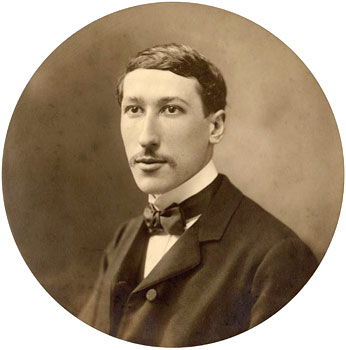
An appreciation of a lifetime of search and writing.
Fifty years ago anyone trying to engage with the teaching of Gurdjieff had few textual resources at their disposal. As a practical teaching, the transmission was essentially oral: in groups and movements. There were good reasons for this. At the end of her preface to the Third Series (published in 1981) Madame de Salzmann quotes Gurdjieff’s own words uttered shortly before his death: “Publish as and when you are sure that the time has come. Publish the First and the Second series. But the essential thing, the first thing, is to prepare a nucleus of people capable of responding to the demand which will arise.” The implication is that this can only be achieved orally in properly directed groups. Texts were very much a secondary affair. The present situation is very different: in addition to the written texts of Gurdjieff the group exchanges he held in Paris during the war have been published – even the movements have been set down in written form. Other texts by those directly in contact with him are now widely available but there is now a growing “secondary” literature, some of it legitimate but much of dubious quality. The existence of the Internet has amplified the noise to such an extent that the teaching itself is in danger of losing direction. In such a context why recommend reading yet another writer – and one who, moreover, says nothing about Gurdjieff? My purpose is to address that question positively, to stimulate a legitimate curiosity in the hope that a useful encounter with what Guénon wrote can take place. My method is to keep my own remarks to a strict minimum and to make use of Guénon’s own words as much as possible.
For those who know nothing of Guénon or his writings some introductory remarks may be of use. The principle which informs all his work is that there is a Tradition of which existing traditions – Hinduism, Buddhism, Judaism, Christianity and Islam – are, as it were dialects. As he says in Oriental Metaphysics: “… pure metaphysics being essentially above and beyond all form and all contingency is neither Eastern nor Western but universal. The exterior forms with which it is covered only serve the necessities of exposition, to express whatever is expressible. These forms may be Eastern or Western; but under the appearance of diversity there is always a basis of unity, at least, wherever true metaphysics exists, for the simple reason that truth is one.” Guénon’s work is an attempt, through a rigorous examination of foundational texts, to clarify the essential nature of this Tradition.
A corresponding aspect of this effort was to expose the various spurious doctrines, such as Theosophy and Spiritualism, which had a certain vogue at the turn of the nineteenth century. He called these movements “counter-traditions” because they were essentially fabrications using misunderstood elements from diverse traditions. As such they constitute a danger for those who might be in search of a genuine teaching. We can see a similar phenomenon in the plethora of New Age groups in our own time, some of which have appropriated elements of Gurdjieff’s work – for example the enneagram. The Internet has magnified the problem. So Guénon’s effort to clarify, to expound the genuine traditions using their basic texts and to expose fabricated doctrines is at least as valid today as it was one hundred years ago.
So what does his work have to offer to a contemporary seeker of truth? It should be said at the outset that he offers nothing of a practical nature. Whenever his presentations of doctrine touch on a practical application he prefers to remain discreet. For example, after discussing at length the difficult notion of apûrva, he writes that “this is a question which has a vast range of application, even in the practical field, though in respect of the latter an attitude of reserve is often advisable; it is preferable to be content with giving a few quite general indications, as we have done here, leaving to each individual the task of drawing from the theory those developments and conclusions that fall in best with his own aptitudes and personal tendencies.” (Introduction to the study of Hindu doctrines, p. 276)
As we find ourselves without any direct contact with the immediate followers of Gurdjieff, two related but contrasting difficulties present themselves. There is a tendency towards systematization on the one hand and towards syncretisation on the other. Concerning the first, Guénon has this to say: “Pure metaphysic necessarily excludes all systematization, because a system cannot avoid being a closed and limited conception, contained in its entirety within more or less narrowly defined boundaries, and as such is in no wise reconcilable with the universality of metaphysic; besides, a philosophical system is always the system of some particular person, that is to say a construction the value of which can only be purely individual.” (Introduction to the study of Hindu doctrines, p. 147) As for the second, Guénon dismisses all attempts to “relate” metaphysics to modern science. The word “metaphysics” denotes what is “beyond physics” so “it may be said that the domain of metaphysic embraces all things, which is an indispensable condition of its being truly universal, as it necessarily must be; but the respective domains of the different sciences remain none the less distinct from the domain of metaphysic, for the latter, which does not occupy the same plane as the specialised sciences, is in no wise analogous to them, so that there can never be any occasion for making a comparison between the results arrived at by the one and by the others.” (Introduction to the study of Hindu doctrines, p. 111) This is not to say that the sciences are invalid, only that their results cannot have a bearing on the Universal. In the book from which I have been quoting, Guénon shows how, in the Hindu tradition, the various “points of view” which correspond to western disciplines such as logic, mathematics and science are all related to, and subservient to, the metaphysical dimension.
Perhaps some readers will be put off by the “intellectual” tone of these remarks but given the temptation to turn this teaching into something rather ordinary – a kind of manual for living – the affirmation of these cosmic dimensions is salutary. His remarks on the difference between a religious and a metaphysical point of view are relevant here: “The influence of sentimental elements obviously impairs the intellectual purity of the doctrine, and it is only right to say that it does in fact represent a certain falling away from the standpoint of metaphysical thought; this falling away in the region where it took place generally and extensively, that is to say in the Western world, was in many ways inevitable and in a sense even necessary, if the doctrine was to be adapted to the mentality of the men for whom it was being specially framed, men in whom feeling was stronger than intelligence in virtue of a predominance that has reached its climax in modern times. Nevertheless, it remains true that feeling is but a relative and contingent thing, so that any doctrine that makes an appeal to it and on which it reacts in its turn is bound to be relative and contingent; and this is especially noticeable in regard to the need for “consolations” with which the religious point of view is closely bound up. Truth, in itself, has no need to be consoling; if anyone finds it so, so much the better for him, certainly, though the consolation he feels does not emanate from the doctrine, but purely from himself and from the particular predispositions of his own sentimentality.” (Introduction to the study of Hindu doctrines, p. 124-5)
Guénon is especially useful in clarifying certain terms, appropriated from genuine traditions, which have entered common parlance in a debased and misleading form. One example is the word karma, which has acquired the thoroughly erroneous meaning of “moral judgement of past actions”. In fact in Sanskrit the word karma means simply action, and in a more technical sense ritual action. Furthermore, “the Sanskrit word rita is related by its root to the Latin ordo, and it is scarcely necessary to point out that it is related even more closely to the word ‘rite’: a rite is, etymologically, that which is accomplished in conformity with ‘order’, and which consequently imitates or reproduces at its own level the very process of manifestation; and that is why, in a strictly traditional civilization, every act of whatever kind takes on an essentially ritual character. (The Reign of Quantity, p. 27 note 1) The order in question is not just social but has a sacred dimension: “In every traditional civilization, as there has often been occasion to point out, every human activity of whatever kind is always regarded as derived essentially from principles…. By this attachment to principles human activity could be said to be as it were ‘transformed’, and instead of being limited to what it is in itself, namely, a mere external manifestation (and the profane point of view consists in this and nothing else), it is integrated with the tradition, and constitutes for those who carry it out an effective means of participation in the tradition, and this is as much as to say that it takes on a truly ‘sacred’ and ‘ritual’ character.” (The Reign of Quantity, p. 56) I will say more about this below.
Given the manifest disorder of our contemporary world it is perhaps not surprising that many have seized on the Hindu notion of the Kali Yuga. However, Guénon’s more precise presentation, derived from original sources, provides much more food for thought about our current situation. As he puts it: “We are now in the fourth age, the Kali-Yuga or ‘dark age’, and have been so already, it is said, for more than six thousand years, that is to say since a time far earlier than any known to ‘classical’ history. Since that time, the truths which were formerly within reach of all have become more and more hidden and inaccessible; those who possess them grow fewer and fewer, and although the treasure of ‘nonhuman’ (that is, supra-human) wisdom that was prior to all the ages can never be lost, it nevertheless becomes enveloped in more and more impenetrable veils, which hide it from men’s sight and make it extremely difficult to discover.” He makes it clear that such a notion of cycles is contrary to the modern assumption of progress. “It will doubtless be asked why cyclic development must proceed in this manner, in a downward direction, from higher to lower, a course that will at once be perceived to be a complete antithesis to the idea of progress as the moderns understand it. The reason is that the development of any manifestation necessarily implies a gradually increasing distance from the principle from which it proceeds; starting from the highest point, it tends necessarily downward, and, as with heavy bodies, the speed of its motion increases continuously until finally it reaches a point at which it is stopped. This fall could be described as a progressive materialization, for the expression of the principle is pure spirituality; we say the expression and not the principle itself, for the latter, being beyond all oppositions, cannot be described by any term appearing to suggest an opposite.” (Crisis of the Modern World p. 6-7)
The nature and function of symbols is a particularly important theme in Guénon’s work. “Symbolism seems to us to be quite specially adapted to the needs of human nature which is not exclusively intellectual but which needs a sensory basis from which to rise to higher levels…Fundamentally, every expression, every formulation, whatever it may be, is s symbol of the thought which it expresses outwardly…symbolism in the strict sense is essentially synthetic and thereby is at it were intuitive, which makes it more apt than language to serve as a support for intellectual intuition which is above reason.” (Fundamental Symbols, p. 13) This last remark should show that Guénon’s approach is far from being reductively intellectual. (Gurdjieff’s remark, in Fragments, p. 279, that symbols were destined for the higher thinking centre is relevant here.) But a sensitivity to symbolic modes of expression is precisely what our Western civilization has lost, for as Guénon remarks: “there are things for which a symbolical mode of expression properly so called is the only one possible, and which will consequently never be understood by those for whom symbolism is a dead letter. It must also be remembered that a symbolical mode of expression is the indispensable vehicle of all teaching of an initiatic character; but, without even considering the profane world and its evident and in a sense natural lack of comprehension, it is enough to glance at the vestiges of initiation that still persist in the West in order to see what some people, for lack of intellectual ‘qualification’, make of the symbols proffered for their meditation.” (The Reign of Quantity, p. 7)
These remarks have a bearing on how a traditional teaching is transmitted and takes us back to what I said in my opening paragraph. “The traditional teaching is handed down under conditions which are strictly determined by its nature: to produce its full effect, it must always be adapted to the intellectual possibilities of each man to whom it is offered, and should be graduated according to the degree of understanding reached at any given moment, and this demands, on the part of a recipient who aspires to advance still further, an unremitting personal effort to assimilate effectively the teaching imparted to him. This is a natural consequence of the way in which the doctrine is treated as a connected whole, and it is this fact which makes necessary the oral and direct teaching which nothing else can replace; indeed, in its absence, the chain of a regular and un-broken ‘spiritual filiation’ is bound to be broken, except in certain quite unusual cases, where continuity can be preserved by other means which it would however be too difficult to describe in a Western language for us to undertake to do so here. In any case Orientals are free from the all too common illusion of the West, which consists in believing that everything can be learned from books, with the result that memory is set up in the place of intelligence; for the Easterner, texts count as no more than ‘supports’ in the sense that we have so often given to that word, and their study merely furnishes the basis for an intellectual development, without ever being mistaken for that development itself; in this way, erudition is given its proper value and is placed on the lower level which normally belongs to it, as a means subordinate and accessory to true knowledge.” (Introduction to the study of Hindu doctrines, p. 290)
In an essay “Rite and Symbol”, which can be found in the collection The Essential René Guénon, the notion of symbol is extended in a very rich way. “It will now be easy to understand that every rite is literally made up of a group of symbols which include not only the objects used or the figures represented, as we might be tempted to think if we stopped at the most superficial meaning, but also the gestures effected and the words pronounced (the latter, as we have said, really constituting moreover only a particular case of the former); in a word, all the elements of the rite without exception; and these elements then have a symbolic value by their very nature and not by virtue of any superadded meaning that might attach to them from outward circumstances without really being inherent to them. Again, it might be said that rites are symbols ‘put into action’, or that every ritual gesture is a symbol ‘enacted’, but this is only another way of saying the same thing. Highlighting more particularly the rite’s characteristic that, like every action, it is something necessarily accomplished in time, whereas the symbol as such can be envisioned from a timeless point of view. In this sense one could speak of a certain pre-eminence of symbols over rites; but rites and symbols are fundamentally only two aspects of a single reality, which is, after all, none other than the ‘correspondence’ that binds together all the degrees of universal Existence in such a way that by means of it our human state can enter into communication with the higher states of being.” (The Essential René Guénon, p. 229-30)
Finally, for those who might be tempted to dismiss Guénon as irrelevant to our teaching, I have it on good authority that after Gurdjieff’s death Mme de Salzmann went to Cairo to try to convince Guénon that the Work is not a counter tradition. She did not succeed, but that she thought it worthwhile to try says a great deal about the respect she evidently had for his work.
It is impossible in such a short piece to do more than indicate the range and diversity, as well as the fundamental unity, of Guénon’s work. At the conclusion of his major work on Hinduism, Man and his becoming according to the Vedanta, he mentions his intention to write a series of studies of oriental metaphysics. Among these I would particularly recommend The Symbolism of the Cross. Fundamental Symbols, a collection of articles written over many years and dealing with such subjects as Symbols of the Centre of the World, the Symbol of the Heart and so on, shows at once the range and unity of his interests. I would also highly recommend The Essential René Guénon, edited by John Herlihy, published by World Wisdom in 2009, which has a useful introduction.
Julian Arloff