
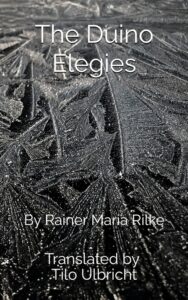
Rilke’s Duino Elegies, a new translation by Tilo Ulbricht.
Raine Maria Rilke (1876-1926) is regarded as one of Germany’s greatest lyric writers. He is also recognised as a mystic, a man whose inner search sought creative expression; a man who having witnessed both the world’s and his own darker side appears to break through to a more positive celebration of life.
It has often been said his German is too hard to translate, that the lyricism of his work cannot be adequately conveyed through another language. It may also be argued that the translators have been unable to fully comprehend the essence of Rilke’s writing because they haven’t travelled a similar path themselves.
In the introduction to Tilo Ulbricht’s newly published translation of ‘The Duino Elegies’, he expresses his own dissatisfaction with previous translations particularly focusing on their understanding, or lack thereof, of the German word ‘Dasein’ meaning ‘being there’.
I have no knowledge of the German language so cannot vouch for the accuracy or truth of this translation in comparison to other translations. There is no doubt as to the personal nature of this translation and the importance of Rilke to the translator.
In addition to this publication, Tilo published ‘Where is my Home’ a selection of short poems by Rilke in 2023. He is a poet in his own right and his selected poems under the title ‘A Journey Towards Myself’ was published in 2025.
Now to ‘The Duino Elegies’ itself. This translation is intended ‘For Lovers of Poetry’ so how does it fare? Poetry is more than words on a page. It needs to be recited and to be heard. You need to feel the flow, to assess whether there is one, to see where you are taken. Some passages may strike you; some may be a chore and add nothing.
So what comes over from within these ten elegies? What do I learn, what can others learn about ‘being there’? The English used is direct, nothing fancy or obscure, mostly in short forceful sentences and then occasionally more lyrical verses, expanding an image, becoming fuller. Rhyme is rare, but repeated phrases and words help to give a rhythm so that the narrator’s voice is both strong and connected. There is a sense of progression, of being on a journey, a spiritual journey rather like those that others such as St John of the Cross or Rene Daumal have described with a mountain to climb at the end and an elusive, if initially scary, companion to journey with and to re-encounter on the way.
I have said the English is direct. It is extremely quotable; the lines stay with you and in Tilo’s translation they can be related to one’s own inner search. Rilke is trying to convey his own observations of an inner journey and his experiencing of different levels of consciousness.
I have heard that Rilke’s Duino Elegies and the Sonnets to Orpheus, both written in the author’s last years need to be experienced together, the first is more about suffering, the latter more about joy. This may be so, but even in the first elegy we have this wonderful line –
“. . .we are
in need of those great mysteries for it is from our sorrows that so often
a new opening to the spirit comes.”
Yes, our pleasures are transitory – “What is ours departs / like heat from a steaming dish.” and “strange how the drinker escapes the experience”! And Rilke can state, as can many of us “in what I call the world I am not at home”. But how many of us have the courage to face our inner fears, to go to “the powerful sources… into the ravines where terror lay”
and to make what could be called a journey from the more subjective to one that is more objective, taking in all that is and reaching towards all that is unknown?
And what is ‘being there’ and what is ‘not being there’? What daily work do we need to undertake? From the 4th Elegy –
“Unlike migratory birds,
we are not attuned…
. . .and somewhere still the lions wander,
not knowing in their majesty of any weakness. ”
And “we do not know the inner shape of feeling. . .” We have only those occasional moments maybe just “an hour, which was yours, when you were.” How might we become more attuned, more feeling?
The 7th Elegy becomes more joyful; there can after all be “a new perception from within” but “real happiness cannot emerge until there has been transformation within”. The implication is that we need to face our fears, contemplate our deaths, accept this to-ing and fro-ing between one world and another, one level of consciousness and another for “none can really pass beyond and so the world takes them again”.
Yes, we are “spectators always, everywhere, turned outward to all that, but never passing through” but the poet is now more confident in the later elegies; Rilke is now walking with the Angel he once fled from and even leaving her behind as he takes his own path.
In reaching the end of his journey, he has come home and is “once more given to see the whole of his valley”. But he walks on, ascending the mountain “almost overwhelmed by the sudden descent of happiness”. It was not an easy journey with no easy answers and one that did not find any comfort in ‘religion’ which proved “as disappointing as a post office on Sunday.”
I have missed out much; you can enjoy your own way through these poems that together do make a whole.
Anthony Smith