Skip Navigation

Letter from Paris - April 2008

Although the tattered remains of last month’s election posters are already peeling off the walls and such names as are legible are for the most part forgotten, the political game of “Who’s in? Who’s out?” is as persistent and vacuous as ever. So, it was with some relief that I made my way to the major exhibition entitled Babylon, at the Louvre. It closes at the beginning of June, and then goes to London and elsewhere. If I begin by making a number of critical comments, it still remains an impressive and stimulating exhibition.

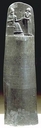
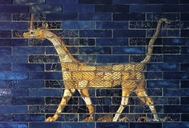
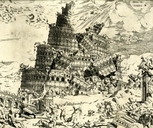
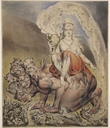
Code of Hammurabi Dragon Ishtar Gate Destruction of the Tower of Babel The Whore of babylon

It is structured and arranged chronologically in a very pedagogical manner, with lengthy texts displayed on the walls which, with their small print and long lines, are not easy to read, particularly in the sombre light. There is a huge, weighty (and expensive) catalogue, which contains a wealth of illustrations and dense rather learned articles. This is far too unwieldy an object to serve as a guide on the spot. The smaller souvenir booklet is not really a helpful companion either, so I bought neither and did my best to take in what I could during my visit. On reflection however, I should have prepared myself better before going, by at least reading one of the books available here. (In French, Jean Bottéro’s Babylone, à l’aube de notre culture, ed. Gallimard, is excellent – if it’s not translated, there are undoubtedly similar things in English).

A further grouse – the exhibition is too large and diffuse. Apart from displays concerning Babylon at its height (3rd and 2nd millennium BC) the story goes beyond the Persian domination, right up to the Hellenic period. Then there is another section concerning the representation of Babylon, from the middle ages right up to the 20th century. This latter is not without interest, but it’s really another exhibition.

With a little effort on the part of the visitor what emerges is very impressive indeed. Most of the items on display are relatively small – but for a small additional outlay the whole of the Louvre is accessible as well, so it is possible to take in the truly amazing palace friezes which are part of the permanent collection. (I’m quite familiar with them, because the Louvre is free on the first Sunday of the month, and I go quite frequently). At the British museum there are among other things the wonderful Ashurbanipal friezes, which all Londoners should get to know.

What emerges with great force is the richness and sophistication of a truly great civilisation: a civilisation of law and the (written) word. The code of Hammarubi (1792-1750 BC) engraved on schist reveals a complex set of laws and punishments concerning everyday life. Particularly moving for me were the tablets of baked clay (there was no local stone) on which the epic of Gilgamesh was recorded in minute, impeccable cuneiform script. These date from the first half of the second millennium BC, but they were probably copies of an earlier version, itself derived from an oral tradition. Its version of the Flood predates that of the Old Testament (there is a good version of the epic in English by Stephen Mitchell).

It was a civilisation that developed artificial irrigation, thus enabling a more extensive cultivation of the land in very difficult climactic conditions. The excavation and maintenance of these canals required a more complex political organization, and a concentration of population into larger city units, rather than scattered villages.

We see evidence of a sophisticated religion, based on the sun, with the sun god Shamash, together with other deities, which have been reincorporated into other mythologies. Precise observation of the stars and planets resulted in the establishment of the zodiac, similar to that found today. A highly sophisticated mathematics (based on six, but with a zero introduced in the second half of the 1st millennium BC) enabled complex calculations, including square and cube roots. They were able to predict solar and lunar eclipses, among other things. A more rigorous way of denominating time segments gave a new meaning and reliability to their historical records.

A truly great civilization, then, but it did not emerge out of nothing, and was part of a whole complex of civilizations over a long period in the area between the Tigris and the Euphrates which goes under the general term Mesopotamia. It is only possible to indicate here some aspects of what was involved, a civilization at once unknown and familiar, as we see themes weaving in and out of well-known Old Testament narratives such as the Fall, the Flood, the “Tower of Babel”…

A great deal has been irredeemably lost; only fragments remain; much has been distorted and rendered largely meaningless – this is particularly obvious in the last part of the exhibition. I was also left wondering what will survive of our own civilization in (say) two or three thousand years. The crowning irony is that a contemporary “war of civilization” has led (predictably) to further destruction of even those fragments which have come down to us.

As far as next month’s letter is concerned, it will be hard to avoid saying something about “May 68” – already the subject here of numerous “debates” and polemics, not to mention articles, books and documentaries.

Julian Arloff

  • In response to a challenge from one of our editors, Julian was asked to clarify what he meant by a great civilisation

The show will be on view at Paris' Musée du Louvre (March 14-June 2, 2008)
and Berlin's Pergamon Museum (June 26-October 5, 2008).
Under the title Babylon: City of Wonder, a more focused presentation will be displayed at
London's British Museum (November 13, 2008-March 15, 2009).

<< | Up | >>

Printer friendly page
This document was last modified on 2008-05-30 13:15:38.